
Welcome to CyberHygiene, my weekly newsletter, where I share tips and actionable data to help everyone stay safe online.
🛡️Law Firms Are Under Siege
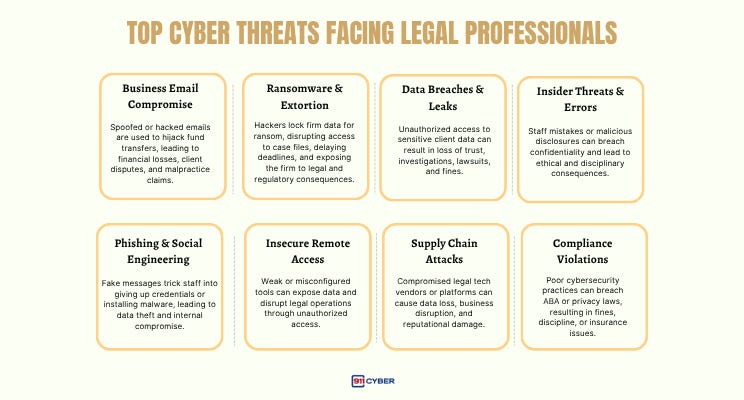
No sector remains untouched by the growing threat of cybercrime, and the legal profession is certainly no exception. In fact, law firms, custodians of highly sensitive client information, intellectual property, and financial data, have become increasingly lucrative targets for malicious actors. The financial and reputational ramifications of a breach can be catastrophic, leading to significant monetary losses, erosion of client trust, and severe regulatory penalties.
In 2024, 40% of law firms reported experiencing a cybersecurity breach, with the average cost per incident reaching $5.08 million, a year-over-year increase of more than 10%. Alarmingly, 56% of these breaches involved the exposure of sensitive client data, putting firms at risk of regulatory penalties, malpractice claims, and permanent reputational damage.
In a world where cyberattacks are escalating in scale, sophistication, and impact, legal professionals can no longer rely on outdated defenses or minimal compliance checklists. Cyber hygiene is now a foundational component of competent legal practice, and the cost of neglecting it is simply too high.
💸 Why Cyber Hygiene Is No Longer Optional
For legal professionals, cyber hygiene has evolved from a behind-the-scenes IT concern into a critical ethical and professional obligation. The American Bar Association’s Model Rule 1.6(c) explicitly requires lawyers to make reasonable efforts to protect client information from unauthorized access or disclosure. Ignoring this responsibility is not just risky; it is a violation of your professional duty that can lead to severe consequences, including malpractice lawsuits, disciplinary actions by state bars, and loss of client trust. In today’s digital landscape, a single cyber lapse can destroy a law firm’s reputation overnight.
The reality is harsh. Firms that fail to implement even basic cybersecurity measures face devastating outcomes. From ransomware attacks that freeze operations to business email compromises that siphon client funds, the fallout can include financial ruin and years of damage control. Legal professionals who neglect cyber hygiene do not just risk data loss; they put their careers and livelihoods on the line. Cybersecurity is no longer optional; it is an indispensable part of competent and ethical legal practice.
🤖 AI Enters the Courtroom: A New Wave of Cyber Threats
The rise of generative artificial intelligence has introduced new and alarming risks for legal professionals. AI-powered tools can create highly convincing phishing emails that are difficult to distinguish from legitimate communications. These sophisticated messages often use personal details and contextual information to trick recipients into clicking malicious links or revealing sensitive information. For law firms, where confidential correspondence is routine, this increased realism makes phishing attacks far more dangerous.
Beyond external attacks, the use of generative AI tools like ChatGPT itself presents a risk of inadvertently leaking confidential information. Lawyers and staff may be tempted to input sensitive client data or case details into AI chatbots to speed up research or drafting. However, many AI platforms store and process this data, which could expose privileged information if safeguards are not strictly followed. Using these tools without proper controls risks violating confidentiality obligations and legal ethics.
Additionally, AI technology has advanced voice synthesis capabilities that enable attackers to carry out voice spoofing and impersonation attacks. Criminals can mimic the voices of clients, partners, or executives, using these synthetic voices to request urgent wire transfers or sensitive documents. Such attacks exploit the trust-based nature of legal workflows and can lead to significant financial losses or breaches of confidential data. As AI tools continue to improve and become more accessible, legal professionals must be vigilant and adopt enhanced verification processes to defend against these emerging threats.
From Reaction to Readiness: Building a Cyber-Resilient Practice
The future of law is digital. And in that future, cybersecurity is a moving target. Legal professionals must shift from reactive crisis management to proactive defense.
Here’s where to begin:
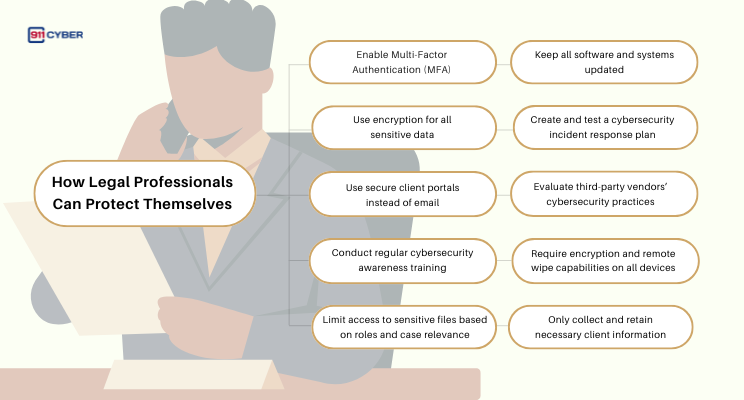
Audit your firm’s current cybersecurity practices.
Train everyone—from senior partners to interns—on modern threats and response protocols.
Secure the software, vendors, and communication tools you rely on daily.
Limit exposure by adopting strict data handling and AI usage policies.
Verify unexpected requests, even when they sound familiar or urgent.
Cybersecurity is not a project. It’s a practice. Like law itself, it requires vigilance, consistency, and discipline.
What resources are available to help protect Legal professionals against cybercrimes?
📚 Books
Cybersecurity Essentials for Legal Professionals: Protecting Client Confidentiality by Eric N. Peterson
Cybersecurity Law (Dec, 2022) by Jeff Kosseff
Cybersecurity Law, Standards and Regulations (2nd Ed.) (2020) by Tari Schreider
Cybersecurity Law: Protect Yourself and Your Customers(2019) by Shimon Brathwaite
🎙️ Podcasts
🛠️ Tools
Password Management : BitWarden
Multi-Factor Authentication (MFA) : Authy / Microsoft Authenticator / Google Authenticator
Secure Communication: Proton Mail / Signal
File Encryption : VeraCrypt
Virtual Private Network (VPN) : Outline VPN / OpenVPN (self-hosted)
Document and Cloud Sharing: Nextcloud
Whenever possible, law firms should prioritize self-hosted tools to ensure maximum privacy, control, and compliance. Unlike cloud-based solutions that rely on third-party data storage, self-hosted platforms give legal professionals full ownership over sensitive client information, internal communications, and case data. This reduces exposure to unnecessary risk, minimizes dependency on external vendors, and helps meet strict confidentiality and regulatory standards. With the right setup, self-hosting can provide enterprise-grade security without sacrificing usability, making it a smart investment for firms committed to safeguarding trust and integrity.
🧠 A Cyber-Savvy Legal Community is a Safer One
Cybersecurity is no longer a one-time checklist for legal professionals. It is a continuous process of learning, adapting, and staying alert. As threats become more sophisticated, especially with the rise of AI-enabled attacks, lawyers must commit to regular training, proactive planning, and strong security practices.
Now is the time to take action. Start by auditing your firm’s cybersecurity posture. Train every member of your team. Review your tools, vendor relationships, and internal protocols. Most importantly, share this knowledge with colleagues and peers. The stronger and more informed the legal community becomes, the harder it is for cybercriminals to succeed. Being a cyber-savvy lawyer means protecting your clients, your reputation, and the integrity of the profession.
