
Welcome to CyberHygiene, my weekly newsletter, where I share tips and actionable data to help everyone stay safe online.
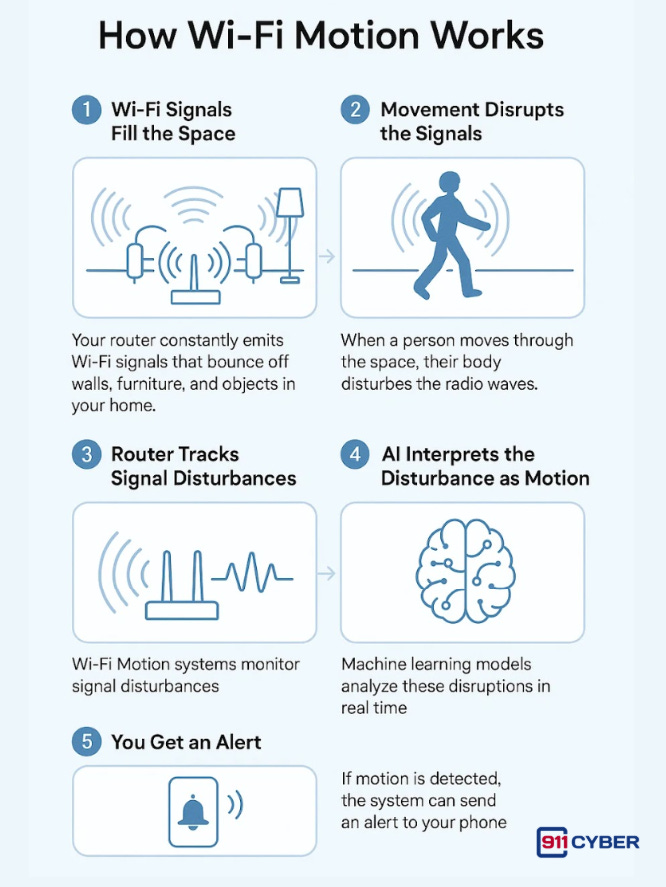
It’s 2 a.m., you pad to the kitchen for water, all the lights are off, and every camera in the house is covered for good measure. You feel alone. Yet the gateway humming on your bookshelf just logged your exact movement and filed it away for possible “sharing” with third parties. Welcome to the brave new world of WiFi Motion.
💸 The shocking upgrade nobody asked for
Comcast quietly rolled out WiFi Motion this year, turning its leased Xfinity gateways (models XB7 and newer) into whole home motion sensors with just a simple checkbox. Up to three ordinary devices such as your printer, game console or smart fridge are converted into motion detecting beacons, and alerts appear in the Xfinity app “at no extra cost”.
😬 The fine print that should make you gulp
Hidden a few paragraphs down, Comcast states it “may disclose information generated by your WiFi Motion to third parties without further notice… in connection with any law‑enforcement investigation, any dispute to which Comcast is a party, or pursuant to a court order or subpoena.”
Translation: the router you rent could testify against you, your kids, roommates, or house guests, without a warrant or a knock on the door.
🚀 From sci-fi to standard feature
This is not a one‑off gimmick. On May 28, 2025 the IEEE officially approved 802.11bf, the first WiFi standard that bakes “sensing” into the protocol itself. Every future WiFi 7/8 router is now a potential radar set by design.
🏠 Why every household is suddenly in the cross-hairs
Cable companies tout “camera-free security,” insurers eye occupancy analytics, retailers crave foot-traffic heat-maps, and governments see a subpoena-ready alibi machine. With 802.11bf now ratified, expect phone makers, mesh-router brands, and smart-home giants to embed motion-tracking as the default. The privacy battle you lose with Xfinity today becomes the baseline for everyone tomorrow.
🌍 Xfinity is just the beginning
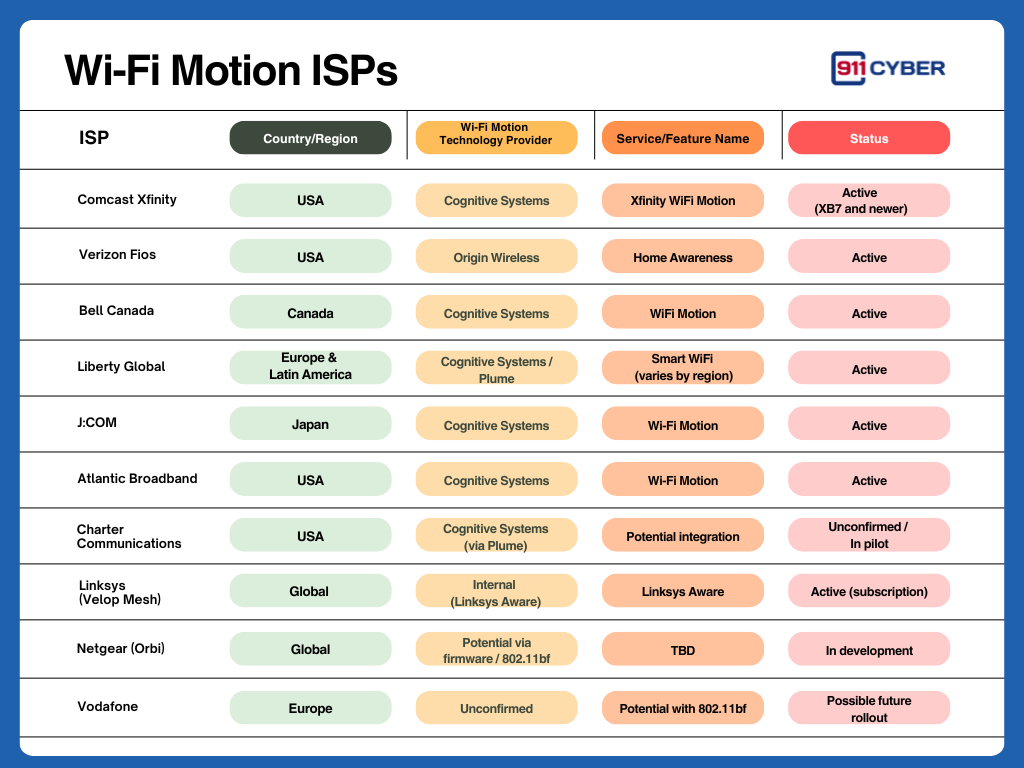
Comcast may be leading the charge in the U.S., but WiFi Motion is quickly becoming a global phenomenon. Canadian company Cognitive Systems, which powers Comcast’s motion-sensing feature, has already licensed the technology to more than 120 internet providers worldwide, reaching over one million homes. Providers in Japan, Canada, and across Europe have quietly integrated similar motion-sensing capabilities into their gateways. Verizon Fios now offers a “Home Awareness” service using Origin Wireless, and Linksys includes motion detection in its mesh systems under the name Linksys Aware. What started as a niche feature is being normalized across the industry, without most users ever realizing their routers are evolving into indoor radar systems.
Notes:
Cognitive Systems is the main engine behind most ISP deployments of WiFi Motion.
Plume integrates Cognitive’s technology into its managed WiFi platform used by multiple ISPs.
The 802.11bf standard, ratified in 2025, means motion sensing may soon be embedded by default in future routers across all markets.
🧍Wi‑Fi can already see your posture
Researchers at Carnegie Mellon demonstrated “DensePose from WiFi,” reconstructing a person’s full body pose through walls using just three cheap routers and a neural network. No cameras, no consent, no line of sight.
🔓 If academics can do it, so can adversaries
A 2025 survey of Wi‑Fi sensing attacks warns that hostile actors can eavesdrop on movement data or spoof signals to falsify what your sensors “see.” Because radio waves are broadcast by nature, most victims never know they’ve been profiled.
🔚 The bottom line
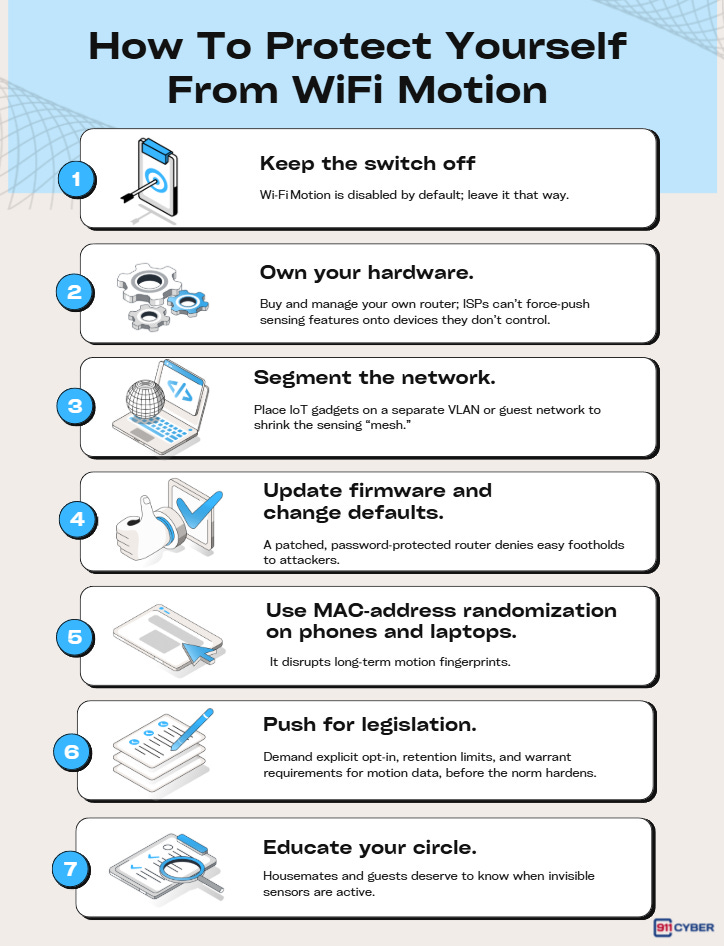
Your WiFi network was once just a conduit for packets; now it is poised to become a silent witness to your daily life. The technology is breathtakingly clever and breathtakingly intrusive. Opt out if you can, lock it down if you cannot, and make noise while regulators still have a chance to catch up. In the age of invisible eyes, privacy favors the early movers.

What Resources Are Available to Help Protect Yourself From WiFi Motion?
📚 Books
Privacy is Power: Why and How You Should Take Back Control of Your Data (2021) by Carissa Veliz
The Home Network Manual: The Complete Guide to Setting Up, Upgrading, and Securing Your Home Network (Home Technology Manuals) (2022) by Marlon Buchanan
The Fundamentals of Wi-Fi Security: A Beginner’s Guide to Protecting Your Wireless Network (2025) by Emily Williams
🎙️ Podcasts
Heavy Wireless by Keith Parsons, Packet Pushers
Security Now by TWiT
📚 Sources
📡 CyberNews – Coverage on Comcast’s rollout of Wi-Fi Motion and its technical capabilities.
📜 Tom’s Guide – Details on Comcast’s privacy policy and data disclosure terms.
📶 IEEE Standards Association – Official ratification of the 802.11bf Wi-Fi sensing standard (May 2025).
🧠 Carnegie Mellon University – Academic paper: DensePose from WiFi (reconstructing human posture with Wi-Fi signals).
🕵️ arXiv – Survey on privacy and security risks of Wi-Fi sensing attacks.
📊 Wi-Fi NOW Global – Industry analysis on 802.11bf’s implications for smart home and commercial deployment.
📉 Comcast Q1 2025 Earnings Report – Broadband customer data and rollout scale.
