Welcome to CyberHygiene, my weekly newsletter, where I share tips and actionable data to help everyone stay safe online.
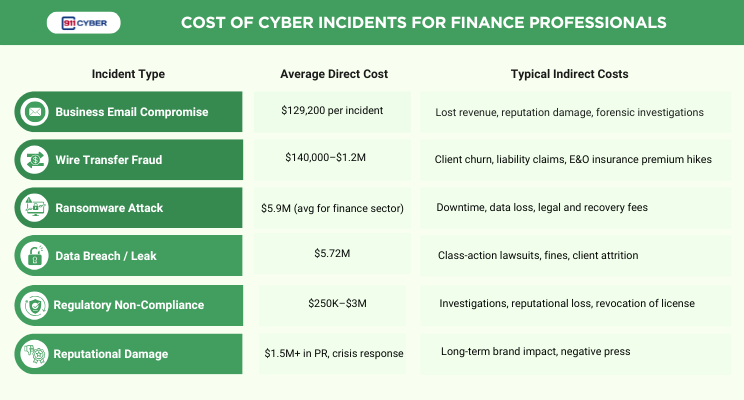
Whether you’re a financial advisor, accountant, controller, CFO, or investment analyst, your profession revolves around sensitive data, and cybercriminals know it. According to IBM’s 2024 Cost of a Data Breach report, the finance sector faces one of the highest average breach costs: $5.9 million per incident. Verizon’s DBIR also confirms that financial professionals are disproportionately targeted in phishing, ransomware, and social engineering attacks.
Finance professionals are the gatekeepers of capital, confidential documents, investment strategies, and client trust. A single mistake can lead to identity theft, financial loss, regulatory penalties, or reputation damage.
🧨 What Are the Biggest Cyber Threats Facing Finance Professionals?
1. Business Email Compromise (BEC)
One of the most costly and deceptive threats, BEC involves attackers impersonating executives, clients, or vendors to trick finance teams into transferring funds. In a high-profile 2015 case, Scoular, a U.S. commodities trading firm, lost $17.2 million after a finance executive received spoofed emails appearing to come from the CEO and a fake Chinese law firm. The message? Always verify wire requests through a second, trusted channel like a phone call.
2. Ransomware
Ransomware can grind operations to a halt by encrypting financial systems and demanding payment for restoration. In 2021, CNA Financial, a major insurance firm, reportedly paid $40 million to regain control of its systems after an attack that also led to data leaks. The key defense? Maintain segmented, secure, and regularly tested backups to reduce reliance on ransom demands.
3. Fake Invoices and Wire Transfer Fraud
Another common tactic involves sending forged invoices or altering vendor payment details to reroute large sums. Toyota Boshoku Corporation fell victim when a finance employee mistakenly wired $37 million in response to a fraudulent invoice. To prevent this, always confirm any changes to payment details directly with a known contact using previously established communication channels.
4. Credential Theft and Account Compromise
Stolen or reused passwords are a gateway to your financial systems. In 2021, Robinhood suffered a breach affecting 7 million users after a customer support employee’s account was compromised via social engineering. This underscores the importance of using password managers, rotating credentials, and enforcing multi-factor authentication (MFA) across all systems.
5. Insider Threats and Human Error
Whether intentional or accidental, insiders pose a serious risk. In 2022, Morgan Stanley faced scrutiny when old servers containing unencrypted client data were sold without being properly wiped, exposing sensitive information. This case highlights the need for strong offboarding processes and rigorous data sanitization protocols during equipment disposal.
6. Regulatory Non-Compliance
Regulators are now holding firms accountable for poor cybersecurity practices. In 2023, the SEC fined several investment advisers up to $1 million each for failing to disclose breaches and for lacking adequate cybersecurity measures. For finance teams, cybersecurity isn’t just an IT concern—it’s a compliance priority that must be managed proactively and documented thoroughly.
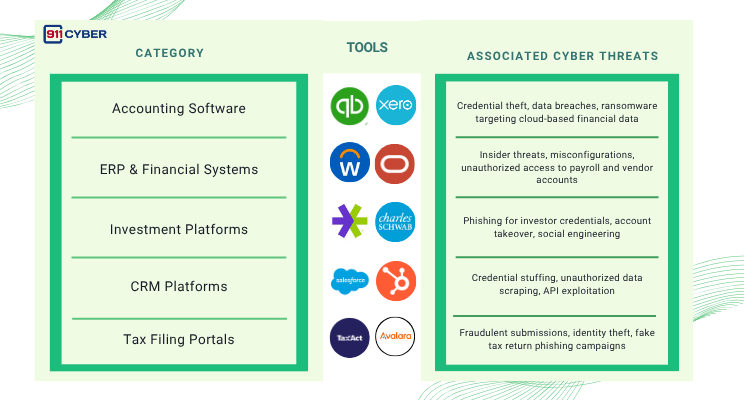
🧰 Tools Finance Professionals Use and the Threats They Bring
🤖 How AI Is Making Things Worse
Artificial Intelligence is transforming finance but it’s also reshaping the cyber threat landscape in dangerous ways. Once reserved for elite hackers, advanced cyber attacks are now accessible to almost anyone with an internet connection and a prompt.
Here’s how AI is already making things worse for finance professionals:
🎯 Hyper-Personalized Phishing
AI can scrape public data, emails, and social media to generate convincing messages that mimic a client’s tone, timing, and context—dramatically increasing click and reply rates.
📄 Realistic Fake Documents
Attackers are now using AI to forge tax filings, investment reports, wire transfer forms, and even PDF statements that look like they came from your own firm.
🤖 Scalable Automated Attacks
AI bots can now scan thousands of targets, test stolen credentials, and simulate normal user behavior to evade detection systems—all at machine speed.
🗣️ Deepfakes & Voice Cloning:
A 10-second audio clip is enough to clone a CFO’s voice. Fraudsters are using this tech in real-time phone scams to request emergency transfers or trick staff into bypassing security.
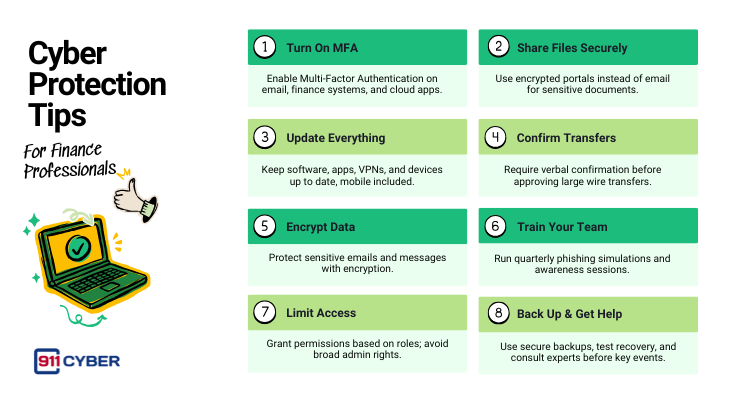
🔐 How Finance Professionals Can Protect Themselves
🔮 What’s Coming Next?
Expect the line between real and fake to blur even further. AI is lowering the barrier to entry for cybercrime while raising the sophistication of attacks. Finance professionals must prepare for a future where every email, voice message, and document might be weaponized, and cyber vigilance becomes a daily discipline.
🦹 AI Chatbots as Scammers
Interactive phishing tools will use real-time conversations to manipulate employees or clients into revealing credentials or transferring funds.
🚫🎥 Fake Video Conferencing
AI-generated deepfake avatars may appear in Zoom or Teams calls, impersonating executives, auditors, or compliance officers.
📉💀 Malicious Financial Modeling
Cybercriminals may soon use AI to manipulate spreadsheets, forecasting tools, or reports to push bad investments or hide fraud.
🤖💼 Synthetic Clients
Entire fake client profiles with transaction history, LinkedIn presence, and document trails, could be used to infiltrate wealth firms or payment systems.
🛡️ What Resources Are Available to Help Protect Finance Professionals Against Cybercrimes?
📚 Books
Cybersecurity in Finance: Protecting Financial Data and Systems by Alfonso Cahero Tatto
Hands-On Cybersecurity for Finance: Identify vulnerabilities and secure your financial services from security breaches by Dr. Erdal Ozkaya and Milad Aslaner
Financial Cybersecurity Risk Management: Leadership Perspectives and Guidance for Systems and Institutions (2018) by Paul Rohmeyer and Jennifer L. Bayuk
Cybersecurity: In The Modern Financial Age by Dr. Enrico Tinazzi
🎙️ Podcasts
FinCyber Today by FS-ISAC hosted by Elizabeth Heathfield
Finsight: The Global Financial Institutions Industry Podcast by Baker McKenzie and Elizabeth Roper, Jessica Nall and Richard Powell
From Risk to Resilience Cybersecurity Strategies for the Next Generation of Banking with Jon Waldman by Rutger van Faassen
▶️ Videos
The Truth Series : Financial Security by Ryan Bucker, schellman
🛠️ Tools
Secure messaging: Signal , ProtonMail, or Virtru
Anti-fraud AI: Stripe Radar, Abnormal Security
Security monitoring: Vanta, Drata , or GCP/AWS GuardDuty
Secure identity management: Okta, Duo Security
Finance Needs Cyber Discipline
Finance professionals sit at the intersection of money, trust, and digital infrastructure. That’s exactly why they’re prime targets. But being a target doesn’t mean you have to be a victim.
By adopting strong cyber hygiene habits, you protect your clients, your team, and your reputation. Just as financial success is built on smart decisions and consistent discipline, so is cybersecurity.
📬 Stay safe, stay alert!
Share this with a colleague in finance who might need a refresher.
